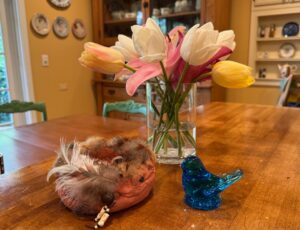
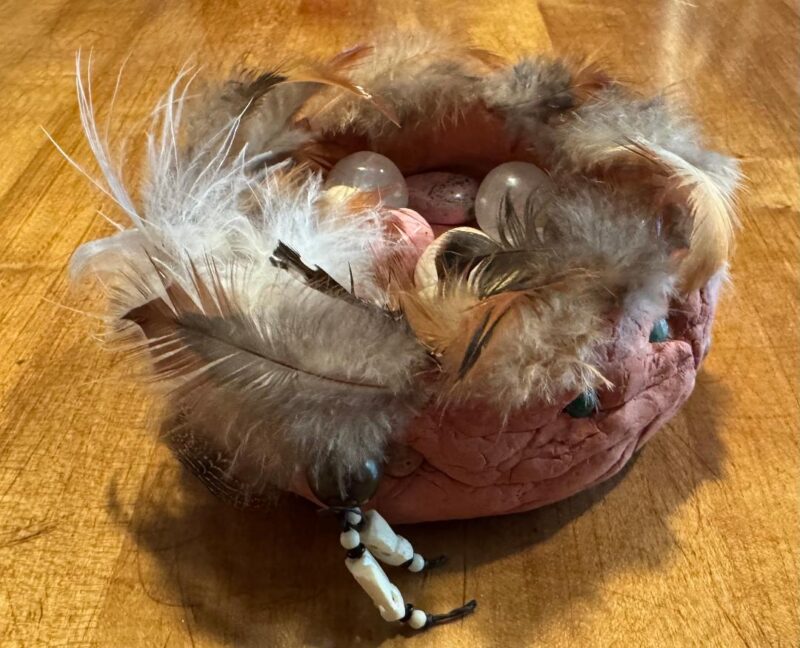
For a few years, I was fascinated by nests. I made them out of wire and cloth. I made them out of twine and material. The one pictured here I made out of clay and beads and feathers. Each one a symbol of a safe place — one that nurtures and protects the young and vulnerable beings who are just starting out here on planet Earth.
I spent hours shaping those nests. Pressing clay with my thumbs. Tucking feathers into the rim. Threading beads onto cord and letting them hang like small prayers. I didn’t fully understand then what was drawing me to this work. I understand it better now.
The nest created by me were more than an art project. They were an act of devotion.
This past April, four astronauts returned from the Artemis II mission — the first human journey around the moon in more than fifty years. When they came back, they didn’t speak in the language of science and data. They spoke in the language of the heart. Christina Koch, one of the mission specialists, looked back at our planet from hundreds of thousands of miles away and said: “Earth was just this lifeboat hanging undisturbingly in the universe… Planet Earth — you are a crew.” Pilot Victor Glover added simply: “I always felt urged to just be grateful for what we were seeing and to be grateful for what we were eventually going back to.”
A lifeboat.
A crew.
Something to return to with gratitude.
They were describing a nest.
What makes this even more poetic is the name of their mission. In Greek mythology, Artemis was the goddess of the wilderness and the moon — but she was also the goddess of childbirth and the fierce protectress of the young and vulnerable. NASA named their lunar program after her. And so four human beings traveled to the edge of the known world, looked back, and saw what Artemis herself might have seen: something small, precious, and worth protecting.
When I look at our world right now, something aches in me. It feels as though we are living in a motherless world. Not everywhere — there are those individual pockets of grace we are so lucky to have in our lives and in our communities. But when I look at the whole of this planet, I think this must be what it feels like to live without that mothering energy. To be without the warmth of arms that say, without words, you are safe here. You matter here.
I want to be clear about something. What I am talking about is not gender. I know men who love and nurture with such tenderness that it brings tears to my eyes. Mothering, as I mean it, is archetypal. It is an impulse toward kindness, toward care, toward making another person’s feelings and circumstances more important than our own, at least for a moment. It is the willingness to turn toward suffering rather than away from it.
And there is so much suffering. So much crying out. So much longing for someone to lean in close and say:
I see you.
I’ve got you.
What I want — what I find myself dreaming of — is to build a nest around planet Earth. To wrap it in something soft and strong. To tuck the whole aching world into a place where it could finally rest and feel: held.
Tended.
Safe.
That may sound impossible. And yet.
Each of us carries within us the power to be that light. In the way we listen. In the way we show up for a neighbor, a stranger, a friend in crisis. In the way we slow down long enough to let someone else’s pain matter to us.
The astronauts saw it from space. We can see it from right here.
This is what mothering looks like now.
Not grand gestures, but quiet acts of devotion.
One small nest at a time.