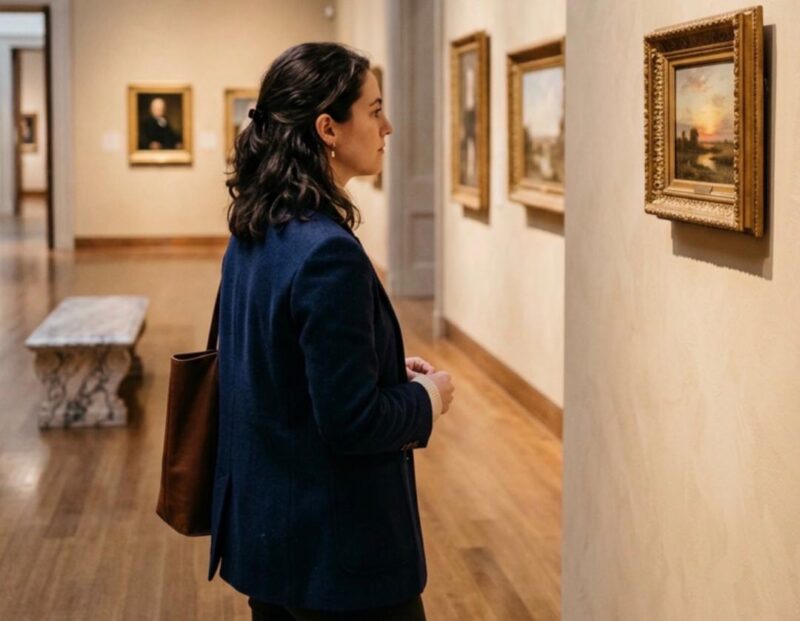
There are mornings when a thought arrives whole, before there is time to question it. This morning brought one of those curiosities: what is it that happens in a museum that feels so close to what happens in a cathedral or temple?
Silence.
Holy air enters the body like a blessing.
In a museum, people bring their hopes and dreams. They bring their pain, their struggles, their disappointments. Some of it seems to hide in the grain of the floorboards, in the stillness of the galleries, in the walls covered with images of women and babies, landscapes, loss, beauty, and the quiet suffering of an ordinary life.
In a cathedral or temple, I feel a similar reaching.
There, too, people have come carrying what cannot easily be spoken. They kneel before holy faces, light candles, breathe incense, whisper prayers. They are searching for an opening—some place where the self can soften, where the soul can come nearer.
The artist and the pilgrim may appear to be doing different things. One stands with a paintbrush in hand. Another stands before a sepulcher, a candle, an altar. Yet both are reaching toward something just beyond where they stand.
Both know, and do not know, what may happen next.
What door may open?
What abyss may ask to be crossed?
I know this place. I know what it is to stand at the edge of language, reaching for something beyond words and images. I know the holy atmosphere of paint and plaster, incense and candle wax.
To stand before a painting can be, for me, a way of standing before something holy.
What makes it holy?
Perhaps it is the yearning of a person to reach past what they know and give form to what lives at the core of their being.
When we stand before a painting we see the brushstrokes, colors, markings, and shadows. Some place in us may sense what lies beneath it. We may feel the longing that led someone to place paint on canvas. For a time, the artist was dancing with something that held them. They felt the music of their own soul and allowed it to move through their hands.
What remains is more than an image. It is a trace of encounter.
As viewers, we do not stand exactly where the artist stood. We cannot enter the precise moment of their making. But we may be pointed in that direction. Something in us recognizes the reach. Something in us remembers.
Art and sacred places draw us because they offer a doorway. They invite us to touch the holy, the sacred, the possibility of wholeness at the center of our own being.
Perhaps that is why a museum can feel like a cathedral.
In both places, we enter quietly.
In both places, we are asked to pay attention.
In both places, something in us begins to pray.
Amen.
If these words resonate with you, experience it firsthand. On October 7, Art Institute lecture Gigi Vaffis and I will lead you on an encounter. A slow, guided experience with paintings paired with poems from Soul Echoes. The afternoon continues at Russian Tea Time for tea, treats, poetry, and quiet conversation.
A few spaces remain. You are welcome to reach out at nancy2daremore@gmail.com to learn more.
Amen.